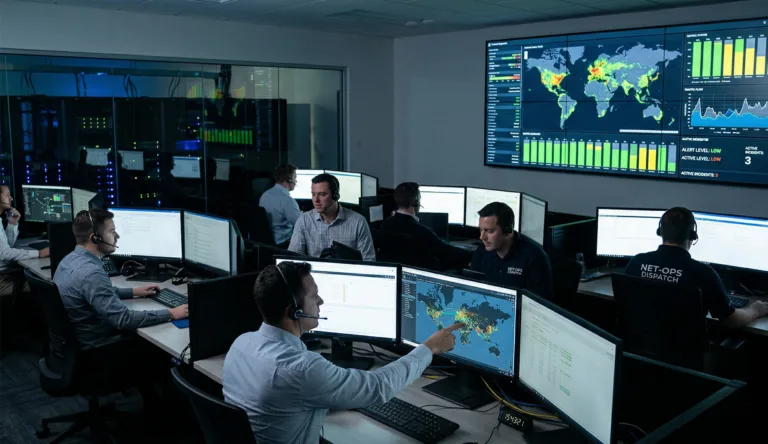
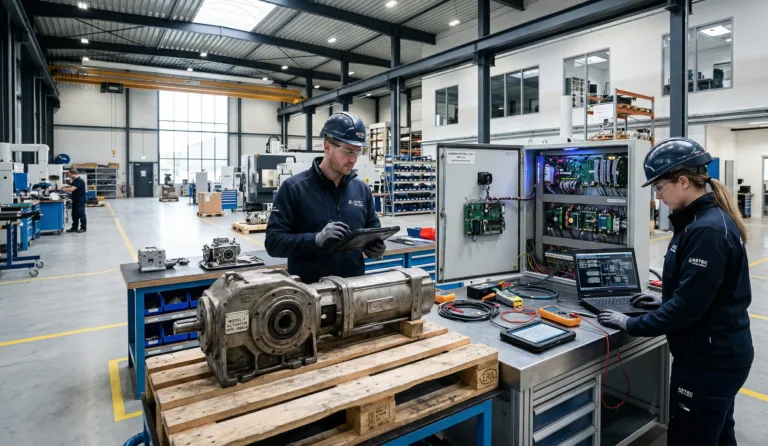
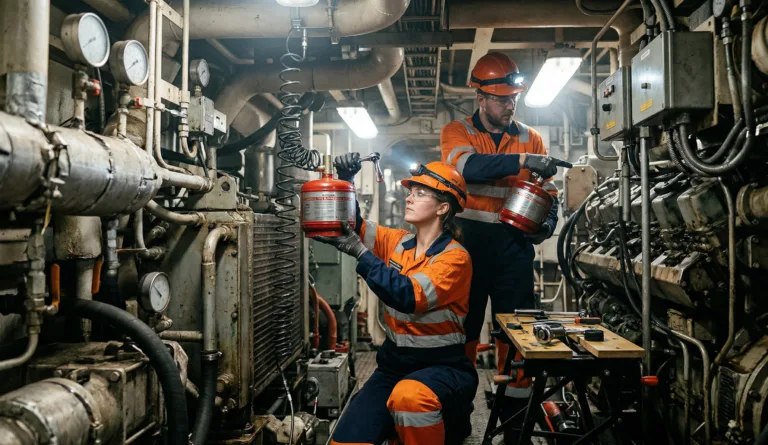
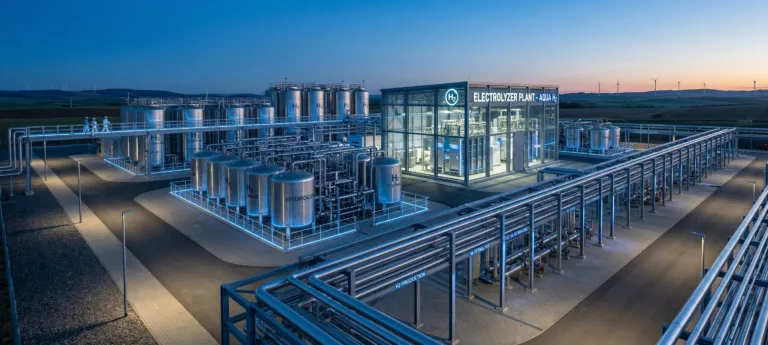
Your strategy looks right on paper and the quarter still slips. We work on the gap between what leadership decides and what teams do on Monday morning.
Explore Services →Most AI pilots work in the demo and stall in the business. We start from the decision you need to make faster, then build the data and tooling that serves it.
Explore Services →A plan fails where it meets contracts and shift patterns. We build the routines and measures that hold up there, and we stay until they do.
Explore Services →
Khamas Innovations is a management consulting and innovation firm based in Dubai. Our background is engineering and program delivery, so we only advise on work we know how to run ourselves.
We work with companies in energy, industrial operations, asset management and infrastructure, usually at the point where a program is too technical for a generalist and too commercial for an engineer. The work falls under Program Management, Sustainability & Renewable Energy, and Digital Transformation.
We would rather hand you one decision you can act on than a hundred slides. So we measure before we recommend, we say when the numbers do not support the plan, and we judge our work by what changed after we left. Ask us what that looked like on the last program.
Your first call is with Abdalla, who founded the firm and leads its engagements. He spent more than ten years running programs in renewable energy and industrial operations before setting up Khamas Innovations in Dubai in 2022.


Most stalled programs are strong in one of these and weak where it meets the other two. Select a circle to see the frameworks we use in each, and where they connect.
Robert Cooper's five-stage governance model. Decision gates separate feasibility from development and launch, so only validated concepts keep their funding.
Clayton Christensen's idea that customers hire a product to make progress on something. Framing innovation around that outcome surfaces opportunities a feature list hides.
A nine-level scale that originated at NASA and is used in EU Horizon and US defense programs. It tells engineers and investors how far a technology is from proven deployment.
Osterwalder and Pigneur's nine-block map of how an organization creates, delivers and captures value. It fits on one page, which is why it gets used.
Kim and Mauborgne's ERRC grid (Eliminate, Reduce, Raise, Create). Teams use it to redraw market boundaries and find demand that competitors are not serving.
Intel's OKR cadence paired with Kaplan and Norton's four perspectives (Financial, Customer, Process, Learning). Together they link board-level intent to what teams do each week.
IoT, AI and cyber-physical systems connected through a digital thread, so you can simulate a change before making it and maintain assets before they fail.
Toyota's waste-elimination discipline combined with Goldratt's bottleneck theory. Find the one constraint that limits throughput, fix it, then find the next.
McKinsey's Supply Chain 4.0 model (AI forecasting, autonomous logistics, digital twins) paired with the Ellen MacArthur Foundation's circular model, for supply networks that move faster and waste less.
Your most important program needs one owner from day one to handover. We take that role, with the structure and reporting that come with it. Which of your projects has no single owner today?
Go to Project Management PageBefore you commit budget, we test whether the idea works technically, pays commercially, and fits the organization you have. You get the evidence, including the parts you were hoping not to hear.
Go to Technical Feasibility PageMost digital programs buy the technology first and look for the benefit later. We start with the outcome you need, then choose the smallest change in systems and process that gets you there.
Go to Digital Transformation PageWe find where work waits or gets redone, and redesign it with the people who do it. That is why the gains are still there a year later.
Go to Operational Excellence PageOne to three days, one room, and a problem your team has discussed for months without deciding. We design the session so you leave with a decision and an owner for each next step.
Go to Workshops & Events PageA prioritized path from the capabilities you have today to the ones your market will expect. Short enough for your teams to follow, specific enough to budget against.
Go to Innovation Roadmap Page
A global enterprise had rolled out a single operating model for its field organization. The model ignored differences in regional regulation, contract types and day-to-day conditions. Costs rose, and teams built workarounds instead of using the system.
We worked alongside frontline teams in each region to map how the work was really done and where the model broke. From that we designed targeted changes, piloted them, and tracked each one against live operational KPIs.
A continuous improvement framework that lets local issues be raised and fixed at source, plus a set of regional variants that allow controlled flexibility. Operating cost fell by $30M and service quality rose. How the variants were defined is the part most people ask us about.

Despite heavy investment in people and systems, planning, scheduling and dispatch were producing poor outputs. The manual cycle was inflating direct cost and lowering the quality of work delivered in the field.
Operations and digital teams were working in separate tools and to separate priorities. We brought them onto one backlog with one rule: the changes with the highest impact and the least implementation friction go first.
A digital maturity assessment showed the distance between the ambition and what the organization could absorb. The roadmap that followed prepared the ground for automated planning, a leaner planning function and better output in the field.

The client's customers were running aging equipment. Performance was declining and legacy components were dropping out of the supply chain. With no upgrade path, obsolescence threatened long-term profitability on both sides.
We built the product strategy on two tracks: efficiency upgrades for existing hardware, and a certified program for refurbished components. Each concept had to pass staged gates before any capital was committed.
The new line extended equipment life by more than a decade and raised operational yield. Refurbished components made supply more dependable and lowered total cost of ownership. It now brings in recurring revenue above €50M.

Critical machinery was running without active fire protection, under high load and close to flammable materials. The client faced possible asset loss, regulatory non-compliance, and an operation that could not be insured under the updated standards.
We delivered a turnkey system: aerosol-based suppression, logic controllers and multi-zone placement, in hardware built for harsh industrial conditions and tested at peak load.
Fire risk exposure dropped and asset uptime improved. The client's HSE score rose to 98%, which met the insurer's requirements and kept the operation running without interruption.

The client could not put numbers on a new technology. Maintenance costs were undefined, the supply chain for specialized components was opaque, and nobody owned the interfaces that decide system performance. The program had stalled between ambition and budget.
We ran a feasibility and operational readiness study and built the O&M cost models and service frameworks from scratch. Technical requirements became budgets and risk mitigations that held up under executive review.
The client moved from speculative planning to an investment position backed by lifecycle cost models. Executive approval followed for a multi-million-euro deployment.
Abdalla impressed me beyond my expectations — able to understand and work with complex ideas and suggest strategic initiatives at the level of an experienced professional. He puts himself in the frontline when actions and decisions have to be made, and is always accountable for what he delivers.
Abdalla translates overall targets into tangible milestones and communicates about them at every level. His grasp of complex technical topics let him catch issues early and de-escalate situations before they even occurred. I can only recommend him for any kind of project or portfolio management work.
How four one-to-one advisory sessions over eight weeks work through one live project: the facts, who decides, the decision paper,…
Read moreUK Treasury guidance tells appraisers to adjust first estimates of cost and duration upward before using them. Most organizations still…
Read moreOne pitch for agentic AI says it ends departmental silos. Two public investigations show organizations where the information existed and…
Read moreSpeak-up training coaches the person with the warning. The accident record and the voice research both point at the person…
Read moreTen yes or no questions to judge whether your project needs a reset day, and the seven things to gather…
Read morePlanning, risk, reporting and stakeholder updates are four project jobs where an AI tool earns its place, as long as…
Read moreA practical method for running a one-day project reset, from the data to request beforehand to the one-page plan the…
Read moreThree fixed-price ways to work with Khamas Innovations: a full-day Project Reset Workshop, a half-day AI in Project Delivery session,…
Read moreTell us what is stuck, in a line or two. The reply comes from the person who would do the work, with a first view on where to start.
Or book a 30-minute call →